01Project Overview
Building and evaluating convolutional neural networks for fine-grained image classification
This project investigates CNN-based approaches for classifying images from CIFAR-100 — a challenging benchmark with 100 fine-grained categories and only 500 training images per class. We explore models trained from scratch, evaluate robustness to Gaussian noise, implement noise-augmented training for improved resilience, and compare against VGG-16 transfer learning.
02Dataset & Preprocessing
CIFAR-100: 60,000 32×32 color images across 100 classes
Data Split
- Training: 45,000 images
- Validation: 5,000 images
- Test: 10,000 images
Augmentation & Normalization
- Channel-wise normalization (μ, σ per channel)
- RandomCrop(32, padding=4)
- RandomHorizontalFlip
- Batch size: 128
03CNN from Scratch
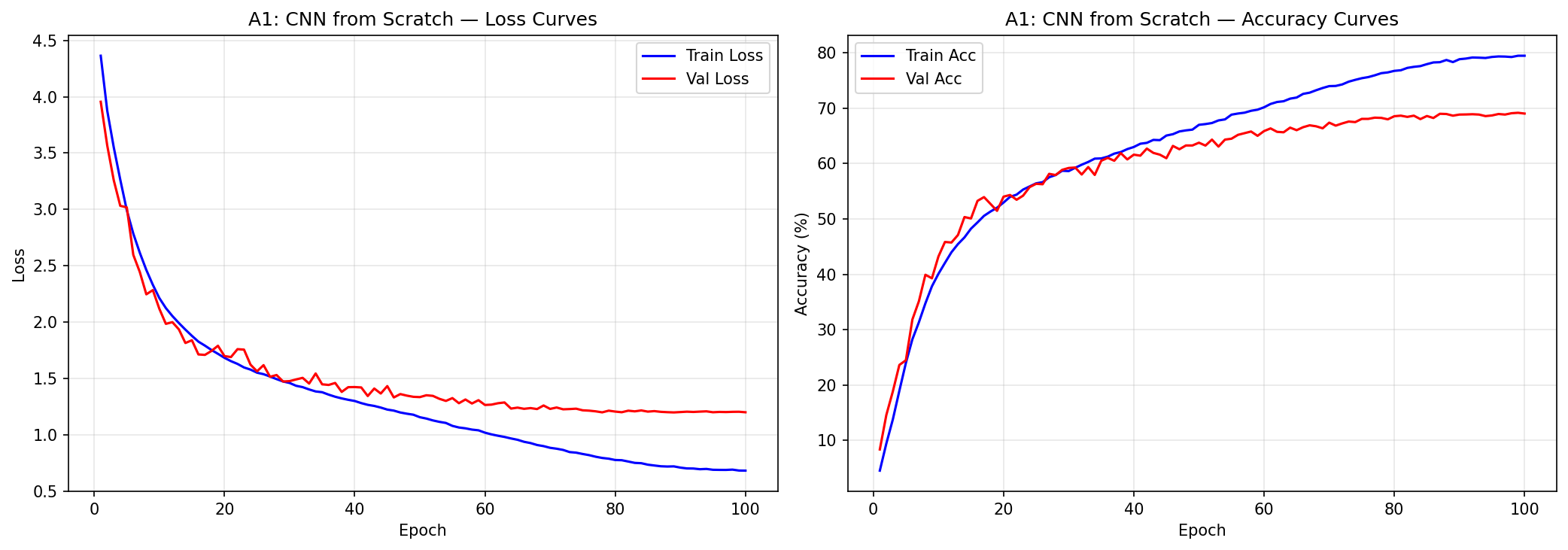
A moderate-depth CNN with progressive regularization
Conv(64→64) · BN · ReLU
MaxPool · Dropout(0.2)
Conv(128→128) · BN · ReLU
MaxPool · Dropout(0.3)
Conv(256→256) · BN · ReLU
MaxPool · Dropout(0.4)
FC(256→512) · ReLU
Dropout(0.5) · FC(512→100)
Training Configuration
- Optimizer: Adam (lr=1e-3, weight_decay=5e-4)
- Scheduler: CosineAnnealingLR (T_max=100)
- Loss: CrossEntropyLoss
- Epochs: 100
- Init: Kaiming He (fan_out, ReLU)
04Noise Robustness
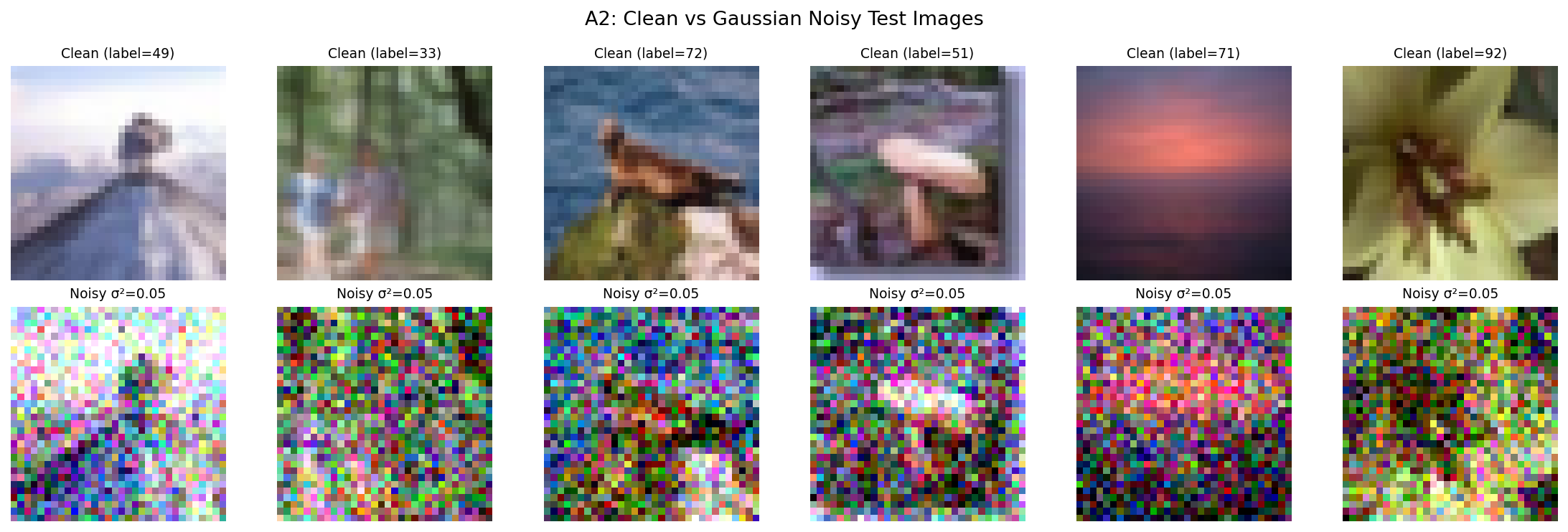
Evaluating and improving resilience to Gaussian noise (σ²=0.05)
Noise Model
Additive zero-mean Gaussian noise: x_noisy = clamp(x + ε, 0, 1) where ε ~ N(0, 0.05)
Standard CNN under Noise
| Condition | Accuracy | Drop |
|---|---|---|
| Clean Test | 69.1% | — |
| Noisy Test | 1.2% | −67.8% |
Noise-Augmented Training
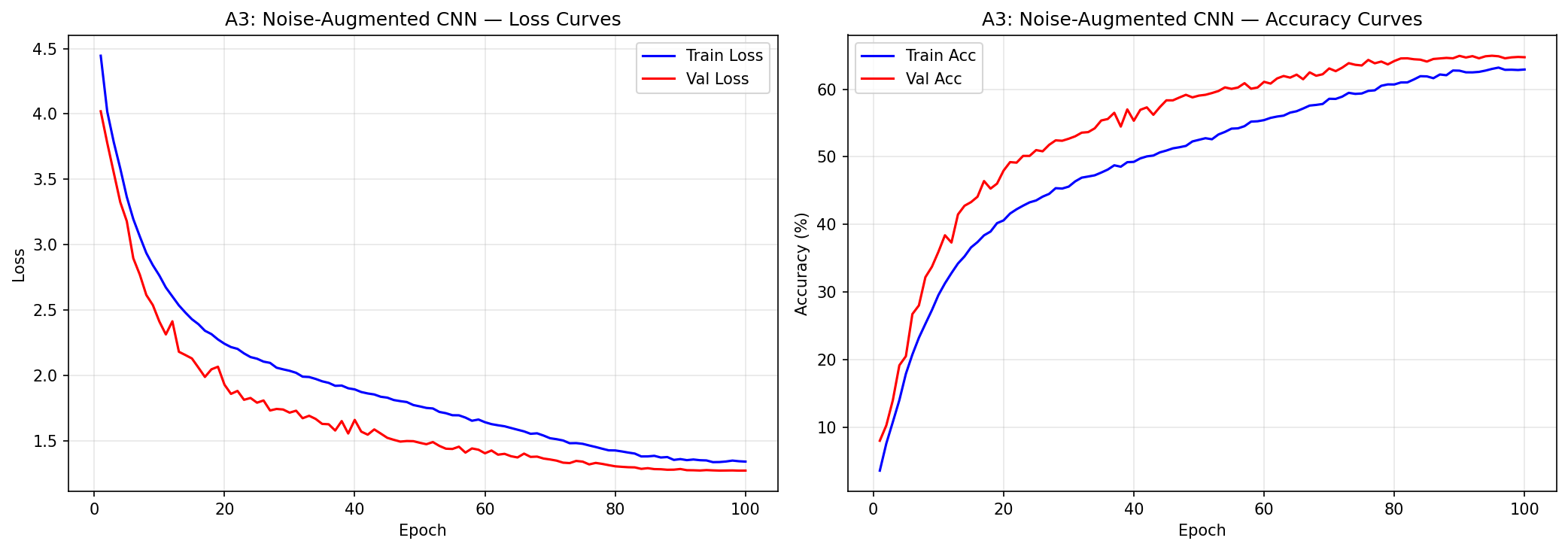
During training, 30% of samples are corrupted with the same Gaussian noise. The model learns noise-invariant features while preserving clean accuracy.
| Condition | Standard CNN | Noise-Augmented CNN |
|---|---|---|
| Clean Test | 69.1% | 64.9% |
| Noisy Test | 1.2% | 47.3% |
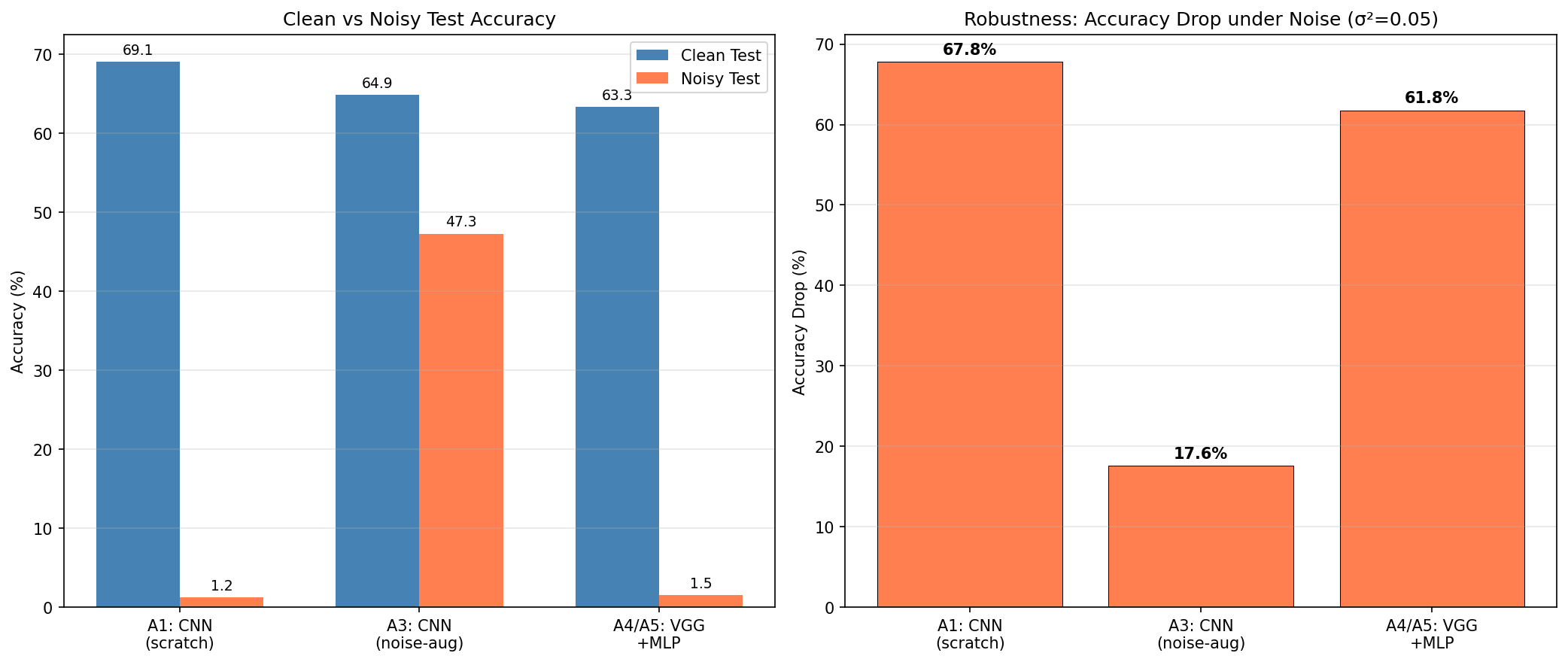
| Accuracy Drop | 67.8% | 17.6% |
05Transfer Learning with VGG-16
Leveraging ImageNet-pretrained features for CIFAR-100
Approach
- Load pretrained VGG-16 (ImageNet weights)
- Resize CIFAR-100 images: 32×32 → 224×224
- Freeze all convolutional layers (feature extractor)
- Extract 512-d features via AdaptiveAvgPool
- Train lightweight MLP classifier: FC(512→256) → ReLU → Dropout(0.5) → FC(256→100)
06Comprehensive Comparison
All experiments side-by-side
| Model | Clean Acc | Noisy Acc | Drop | Params |
|---|---|---|---|---|
| bestCNN (scratch) | 69.1% | 1.2% | 67.8% | ~2.4M |
| robustCNN (noise-aug) | 64.9% | 47.3% | 17.6% | ~2.4M |
| transferVGG-16 + MLP | 63.3% | 1.5% | 61.8% | 138M + 157K |
Key Takeaways
- Best clean accuracy: CNN from scratch (69.1%) — small and effective
- Best robustness: Noise-augmented CNN — smallest accuracy drop (17.6%) with competitive clean performance
- Transfer learning: VGG-16 provides strong results with minimal training, but offers no noise robustness
- Most efficient: CNN from scratch — 2.4M params vs 138M+ for VGG
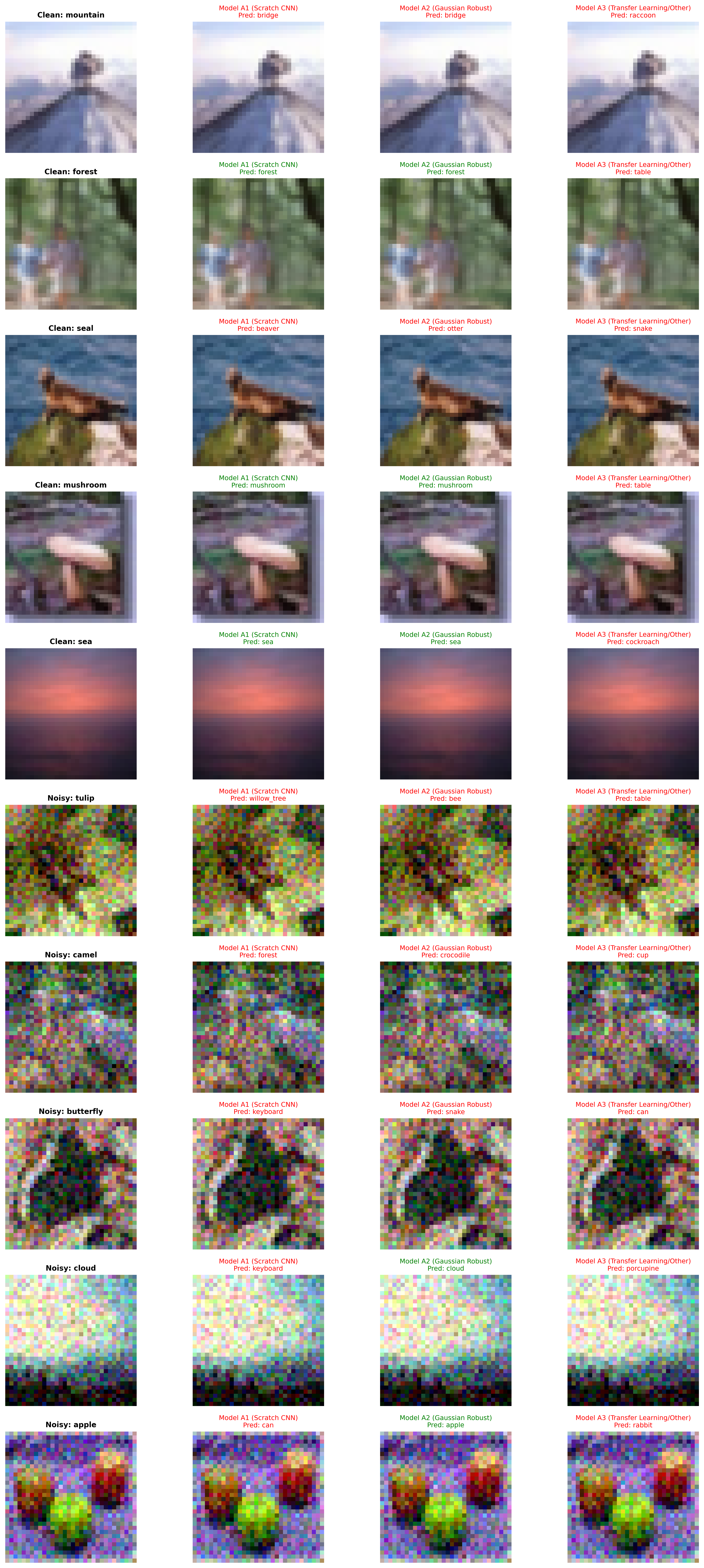
07Model Output Comparison